
Vishing - Deep dive

Vishing—short for Voice Phishing—is the phone-based sibling of traditional email phishing. Instead of tricking you into clicking a malicious link in an email, a visher uses a phone call to a work or personal device to manipulate you into revealing sensitive information, sending money, or granting remote access to your devices.
While traditional phishing relies on text and graphics, vishing leverages the most persuasive tool in social engineering: the human voice.
How a Vishing Attack Works
Most successful vishing attacks follow a distinct four-step playbook:
[ Reconnaissance ] ➔ [ Caller ID Spoofing ] ➔ [ Psychological Manipulation ] ➔ [ Credential Extraction ]
1. Reconnaissance
Scammers gather basic details about you from social media (LinkedIn, Facebook), data breaches, or public records. Knowing your name, employer, or recent purchases makes their story significantly more convincing.
2. Caller ID Spoofing
Attackers can manipulate your screen to display any caller ID they want—your bank, local police, tech support, or even a colleague.
3. The Psychological Hook
Vishing relies heavily on emotional triggers to bypass critical thinking:
Urgency/Fear: "Your bank account is being drained right now!"
Authority: "This is Officer Davis from the IRS."
Helpfulness: "Hi, this is IT—we're fixing a server issue and need to verify your login."
4. The Extraction
Once you're hooked, they push for the payoff: asking you to put credentials or a multi-factor codes in a look-a-like login page for your company; ask for your credit card number, Social Security Number, or asking you to install remote control software like AnyDesk or TeamViewer.
Common Vishing Scenarios
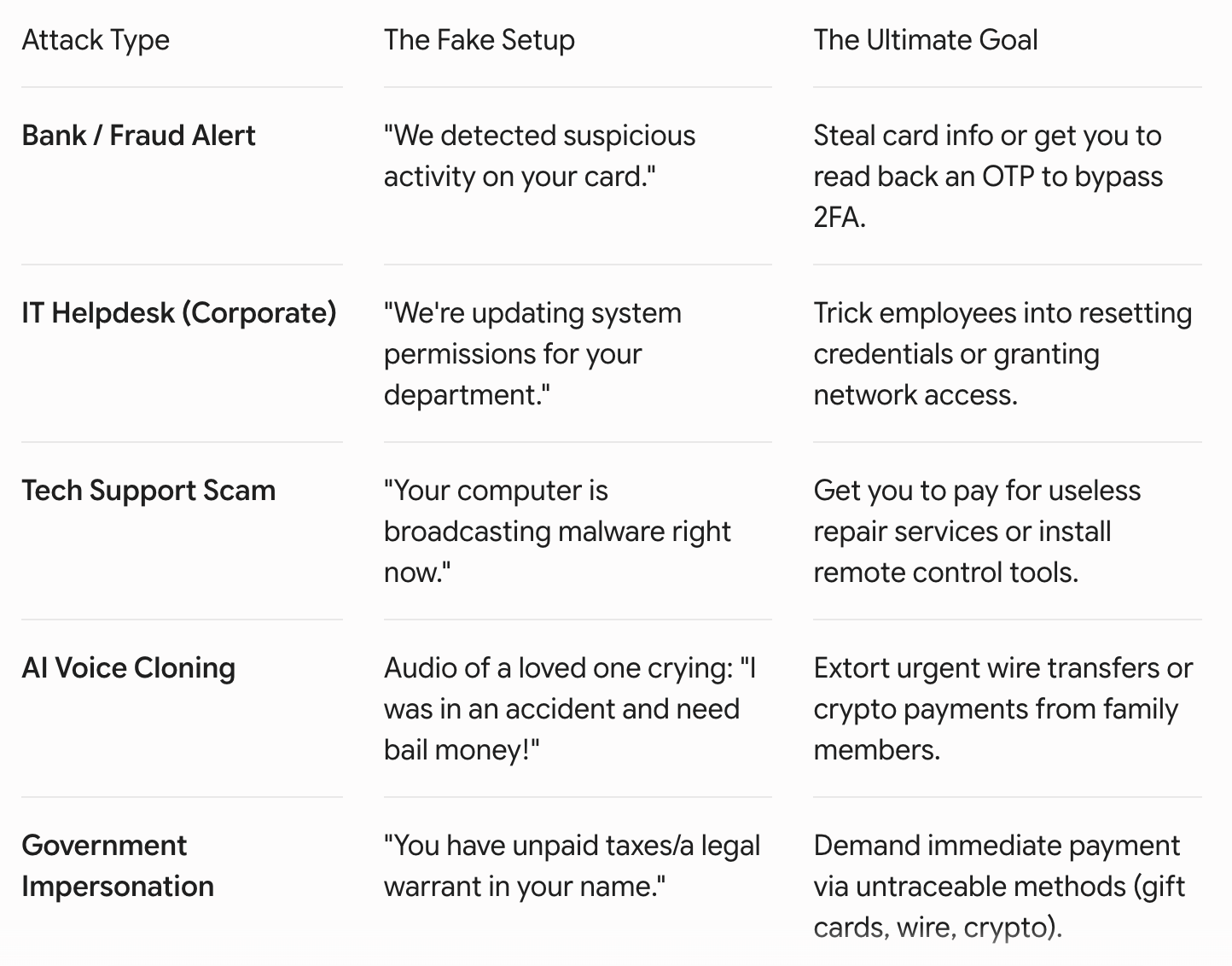
Real-World Impact: Security reports show that vishing activity surged by 442%, with Mandiant ranking voice phishing as the #2 most common initial breach vector across enterprise incident response investigations as of July 2026.
Why Vishing Is So Effective
Human Bias: We are wired to trust vocal cues, tone, and conversational rhythm far more than static text.
Speed & Panic: Phone calls happen in real-time. Unlike email, you don't have time to pause, research, or inspect a link before answering a question.
The AI Boom: Attackers can now use just a few seconds of audio scraped from social media to clone a family member's or boss's voice with eerily accurate cadence and tone.
Red Flags to Watch Out For
Demands for immediate action or requests to keep the call secret.
Requests for MFA/OTP codes. Legitimate institutions will never call you and ask for a one-time code sent to your phone.
Unusual payment requests (gift cards, wire transfers, Zelle/Venmo, or cryptocurrency).
Pressure to install software on your computer or phone.
How to Defend Yourself
Hang up and call back: If your bank or a government agency calls unexpectedly, hang up immediately. Look up the official customer service number on the back of your card or official website, and call them directly.
Never share OTPs or MFA codes: Treat one-time passwords and MFA codes like your personal PIN, never share them over the phone.
Set up a Family Codeword: To combat AI voice-cloning scams, establish a secret word or phrase with close family members to verify their identity during urgent emergency calls.
Don't rely on Caller ID: Always assume caller ID can be faked.