

• Explore
  • Blog
  • Podcast
  • Community
  • About
  • Services
  • Contact
Menu

Exploring Information Security

Securing the Future - A Journey into Cybersecurity Exploration
  • Explore
  • Blog
  • Podcast
  • Community
  • About
  • Services
  • Contact
No results found

How Cybercriminals Use Public Data to Target Our Employees

August 12, 2026

This was written for a security awareness program. Feel free to grab within your own program.

Before a hacker ever sends a phishing email, text, or picks up the phone to launch a vishing call, they do their homework. Modern cyberattacks are rarely random. Instead, attackers spend days (sometimes weeks) building a detailed profile of an organization and its employees using information readily available on the internet.

This process is known as Open Source Intelligence (OSINT) gathering. By piecing together small snippets of public data from social media, corporate websites, and job boards, threat actors can craft shockingly convincing scams that bypass human suspicion.

What Attackers Are Looking For

Cybercriminals look for specific pieces of information to make their impersonations look and sound authentic.

1. Organizational Structure and Reporting Lines

Using professional networking platforms like LinkedIn, attackers construct exact organizational charts. They map out who works in finance, who handles IT, and who reports to whom. Knowing that Jane is the direct manager of Alex allows an attacker to call Alex posing as Jane, leveraging natural workplace authority.

2. Internal Software and Tech Stacks

Attackers scrutinize public job postings and employee resumes to see what tools our organization uses. If a job listing mentions experience with specific VPNs, SSO platforms, or cloud infrastructure, attackers know exactly which login portals to spoof or which IT scenarios to invent when calling an employee.

3. Out-of-Office Indicators and Personal Schedules

Public posts on social media about vacation plans, attendance at industry conferences, or business travel give attackers the perfect window to strike. If an executive posts about being in a three-day, off-site meeting, an attacker can email their team claiming: “I'm in a conference with no cell service. Urgently process this request for me!”

4. Personal Identifiers and Contact Information

Phone numbers, work emails, personal email addresses, and even pet names or hometowns (often used to answer security questions) are gathered from public records, personal social channels, and historic data breaches.

How Online Data Turns Into a Cyberattack

Once an attacker builds a profile, they use that context to lower your defenses:

  • Hyper-Targeted Spear Phishing: Instead of a generic spam message, you receive an email referencing your actual department, your current project, or a real software vendor the company uses.

  • Precision Vishing (Voice Phishing): A caller claims to be from internal IT support and mentions your direct manager's name, your office location, and the exact tool you use to log in every morning. Because they know these details, the call feels legitimate.

  • Credential Stuffing: Attackers cross-reference work email addresses against leaked databases from breached personal websites, testing if employees reused personal passwords for work accounts.

 Have I Been Pwned is a great site to identify what breaches your personal email address is included in: https://haveibeenpwned.com/

3 Ways to Shrink Your Digital Footprint

You don't need to delete your online presence to stay safe, but adopting smart digital hygiene makes our organization a much harder target.

1. Audit Your Social Media Privacy Settings

Review privacy settings on personal platforms like Facebook, Instagram, and X. Restrict public viewing so that personal photos, family details, and real-time locations are only visible to trusted connections.

2. Be Mindful of Work-Related Details

Avoid posting photos that reveal security badges, office whiteboards, internal software dashboards, or specific project milestones. On professional platforms like LinkedIn, consider keeping job descriptions high-level rather than detailing specific internal software versions or architecture. 

3. Remember: Familiarity Does Not Equal Authenticity

Just because an inbound caller or email sender knows your manager's name, your job title, or what tools you use does not mean they are who they claim to be. All of that information can be found online in minutes. Always verify unexpected requests through trusted internal channels.

The Bottom Line

Cybersecurity isn’t just about firewalls and complex passwords—it’s about awareness. Attackers rely on us oversharing online to build their attacks, but you hold the power to starve them of that data.

Take 10 minutes today to audit your social media privacy settings, search yourself online, and practice healthy skepticism when unexpected requests hit your inbox. By tightening your digital footprint, you become the strongest line of defense for both your personal life and our organization.

In Advice Tags data breach, OSINT, security awareness
Comment
2018-12-26 23_10_38-We are OSINTCurio.us – Helping the OSINT community stay curious.png

Curious about OSINT?

December 27, 2018

Check out https://osintcurio.us/. It’s a new site authored by several pretty well known names in the industry. How it got started is a mystery (how I got invited is even more of a mystery).

I’m really excited for the site. There are already 11 posts on the site (including my origin post), including one about Python and how to use it for OSINT purposes. As with other communities I’ve contributed to, there’s a lot of excitement to start. Then it dies off. I don’t think this is the case here. There’s a lot of people involved that are really into OSINT. Most of them are regular contributors. I hope I can match their energy for this site.

This post first appeared on Exploring Information Security.

In Media Tags OSINT
Comment
2018-10-11 20_07_58-OSINT - Google Search.png

OSINT resources for beginners

October 22, 2018

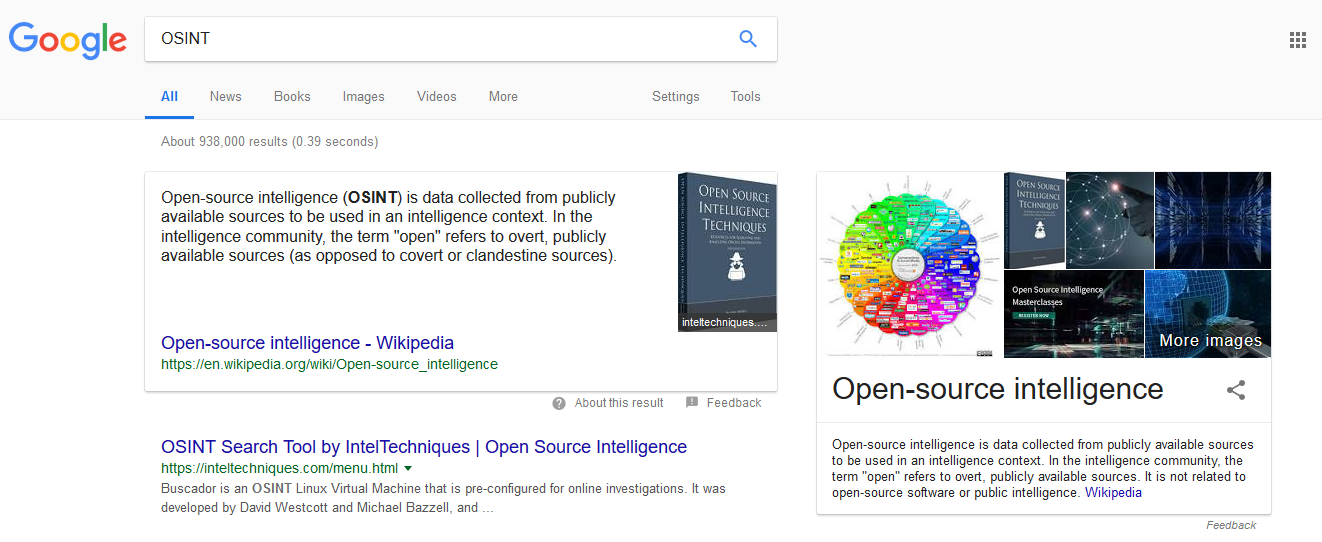
I know what you’re thinking, “not another resource for OSINT.” This post is more focused on helping people just getting started with open source intelligence (OSINT).

This is the second of several resource posts I’d like to do that point people to some getting started resources. This is not meant to be an exhaustive list. Instead I’d like to highlight some of the resources I have found useful and use on a regular basis. This is meant more as a gateway into the deep field of OSINT.

Websites:

  • Google

  • IntelTechniques

  • OSINT Framework

Google is the primary tool I use for doing searches. Learning how to Google Dork is one of the most useful skills to have in security, not just OSINT. IntelTechniques has a lot of useful tools for doing specific searches. OSINT Framework has over 1200 tools available for OSINT. Plenty of opportunity to fall into rabbit holes.

People:

  • Josh Huff

  • Tazz

  • Micah Hoffman

  • Justin Nordine

  • Kirbstr

These are all people I’ve interacted with regularly or had on the podcast previously to talk about OSINT and threat intelligence.

Training:

  • SANS SEC487

  • Social Engineer - Advanced OSINT

  • Justin Nordine’s course

I took SANS SEC487 earlier this year and it is exhaustive. Lots of information, tools, and methodology in the course. I also recently took Social Engineer’s Advanced OSINT course at DerbyCon. It’s a shorter and much more focused course. It provides opportunities to play with certain techniques (Google Dorking) and tools (Maltego). Recently, Justin told me he was doing an OSINT course. Follow him on Twitter (above) to keep up with dates and links.

Podacsts:

  • OSINT on Exploring Information Security

I think this is the easiest way to capture all the podcast content. Plus, it keeps this blog post a little shorter and more streamlined. I don’t want this to be a super long post. The links I’ve provided in this post will lead you to other resources, tools, and ideas in OSINT.

How to get started with OSINT

Something to think about is use cases. Penetration testers use OSINT for assessing and organizations security aptitude. Investigators use it to track down people and companies. Incident responders use it to track malicious domains. Threat hunters use it to identify threats and risks to an organization. Those are some of the things I’ve used OSINT for working on a blue team. I’ve heard of use cases for police, insurance companies, and organizations looking to make acquisitions.

Methodology is also really important. It’s what keeps us from jumping too far down a rabbit hole. Dutch OSINT Guy has a good post on methodology. It’ll take practice and experience, so really just go do it and learn.

This blog post first appear on Exploring Information Security

In Technology Tags OSINT, Resources
Comment
Snow in McLean, VA

Snow in McLean, VA

SANS SEC487 Open-Source Intelligence Gathering and Analysis

March 28, 2018

Last week I had the pleasure of attending the brand new SANS course for OSINT in McLean, VA. The creator of the course, Micah Hoffman, has been on the podcast a few times and someone I consider a friend. He'll make his fourth appearance in a future episode on the topic of the SEC487 course. I wanted to take this opportunity to give some impressions of the course, while it's still relatively fresh.

Micah created videos for help with the labs as part of the course. This was one candid moment from those videos.

Micah created videos for help with the labs as part of the course. This was one candid moment from those videos.

Simply put, the course is fantastic. I recommend it for those with OSINT experience and those without. I have some OSINT experience. As part of my job, I've investigated internal and external people. Working in a Security Operations Center (SOC) for the State of South Carolina, I did a lot of OSINT looking up IP addresses, URLs, and various other things. I've used it to figure out if a marketing or technical recruiter email is legitimate. I've used it in job hunting.

I still took quite a bit away from the course. I took 18 pages of notes. Another project idea came out of the course, OSINT for the Blue Team. I couldn't wait to get back to work to start building out some OSINT standard operation procedures (SOP). I've already taken my notes and built out a resource page for others to use.

I got to build my first sock puppet. Work on better documentation (I love mindmaps for documentation!). I used Tor for the first time and visited the "dark web." Got a ton of new tools and resources to check out. I'm excited to start using Hunchly and Spiderfoot as part of my processes.  The capture the flag (CTF) on day six was fun and engaging.

We laughed a lot. If you're in the area, I recommend Super Chicken and the food trucks on Pinnacle Drive. Center of the Universe brewing has got some really good beer. Which reminds me, Untapped is a gold mine for OSINT. I got to see snow (see above)! Best of all, I got to see Micah teach a five-day course on one leg. He got really good at the three-point turns towards the end of the week.

Enjoying #SEC487 with @webbreacher! Learning tons of OSINT goodness already.

A post shared by Timothy De Block (@timothydeblock) on Mar 19, 2018 at 8:02am PDT

The course was a beta, so it had it's rough moments. Those were rare. Most of the feedback I had was for improving the course. Moving content to earlier in the week rather than later. Maybe doing a little less on this topic here or more of that topic there. The course is solid and it's only going to get better.

Future dates include:

  • Denver, CO - May/June 2018(not listed yet)

  • Baltimore, MD - September 10-15, 2018

  • Las Vegas, NV - September 23-28, 2018

  • Singapore, Singapore - October 22-27, 2018

Click here for more details.

This blog post first appear on Exploring Information Security.

In Experiences Tags OSINT, SANS
Comment

Latest PoDCASTS

Featured
May 5, 2026
[RERELEASE] What is the perception of information security - part 2
May 5, 2026
Read more →
May 5, 2026
April 28, 2026
[RERELEASE] What is the perception of information security - part 1
April 28, 2026
Read more →
April 28, 2026
April 21, 2026
Exploring the Quantum Horizon: Why We Need CBOMs Today
April 21, 2026
Read more →
April 21, 2026
April 14, 2026
Exploring the Risks of Model Context Protocol (MCP) with Casey Bleeker
April 14, 2026
Read more →
April 14, 2026
April 7, 2026
From Combat Zones to Corporate Lobbies: A Guide to Physical Security with Josh Winter
April 7, 2026
Read more →
April 7, 2026
March 31, 2026
[RERELEASE] What is a SIEM?
March 31, 2026
Read more →
March 31, 2026
March 24, 2026
[RERELEASE] What is threat modeling?
March 24, 2026
Read more →
March 24, 2026
March 17, 2026
[RERELEASE] What is cryptography?
March 17, 2026
Read more →
March 17, 2026
March 10, 2026
[RERELEASE] What is a Chief Information Security Officer (CISO)
March 10, 2026
Read more →
March 10, 2026
March 3, 2026
Exploring The Bad Advice Cybersecurity Professionals Provide to the Public
March 3, 2026
Read more →
March 3, 2026

Powered by Squarespace